

Hi there! How can we help you today?
Sensor Integration & Data Acquisition Setup
Overview
Virospuk provides sensor integration and data acquisition (DAQ) setup services for experimental systems, laboratory environments, and engineering validation platforms. The objective is to enable accurate, reliable, and real-time measurement of physical parameters essential for analysis, control, and decision-making.
Modern experimental setups depend heavily on the quality of data they generate. Improper sensor selection, poor integration, or inadequate data acquisition architecture can lead to inconsistent results and unreliable conclusions. Virospuk addresses these challenges by designing structured, application-specific measurement systems that ensure data integrity and repeatability.
Scope of Work
The service covers the complete lifecycle of measurement system development, from parameter identification to system deployment and validation.
Parameter Identification
The first step involves understanding the application and identifying the critical parameters that need to be measured. These may include:
- Temperature
- Pressure (low, medium, or high vacuum ranges)
- Flow rates (gas or liquid)
- Voltage and current
- Force, displacement, or vibration
- Plasma characteristics (where applicable)
Each parameter is evaluated in terms of required accuracy, response time, and operating conditions.
Sensor Selection and Specification
Sensor selection is carried out based on technical requirements and environmental constraints. Factors considered include:
- Measurement range and sensitivity
- Accuracy and resolution
- Operating temperature and pressure conditions
- Compatibility with vacuum or controlled environments
- Electrical interface and signal type
Typical sensors integrated include:
- Thermocouples and RTDs
- Pressure transducers and vacuum gauges
- Flow sensors
- Voltage and current sensors
- Optical and proximity sensors
The goal is to ensure that each sensor is well-matched to the application and capable of delivering stable, repeatable measurements.
System Architecture Design
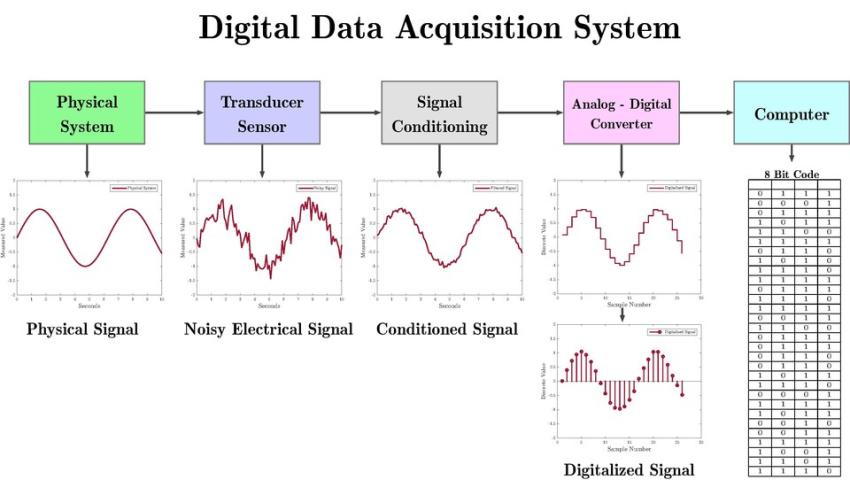
Once sensors are selected, the overall data acquisition architecture is defined. This includes:
- Signal flow from sensor to acquisition system
- Selection of DAQ hardware or microcontroller-based systems
- Channel configuration and sampling strategy
- Synchronization requirements for multi-sensor systems
The architecture is designed to balance performance, scalability, and cost, depending on the complexity of the application.
Signal Conditioning and Integration
Raw sensor outputs often require conditioning before they can be processed. Virospuk designs and integrates appropriate signal conditioning solutions, including:
- Amplification of low-level signals
- Noise reduction and filtering
- Isolation for high-voltage measurements
- Analog-to-digital conversion
Proper signal conditioning is critical for maintaining data accuracy, especially in environments with electrical noise or extreme operating conditions.
Data Acquisition System Setup
The DAQ system is configured to capture, process, and store data efficiently. This may involve:
- Integration of DAQ modules or embedded systems
- Configuration of sampling rates and data logging intervals
- Real-time data visualization interfaces
- Storage and export of data for analysis
Depending on the application, systems can be designed for standalone operation or integration with external control systems.
Calibration and Validation
To ensure reliability, the complete measurement system is calibrated and validated. This includes:
- Verification of sensor accuracy
- Cross-checking with reference instruments
- Stability testing over time
- Validation under actual operating conditions
Calibration ensures that the data collected is consistent and suitable for analysis or reporting.
Integration with Experimental Systems
The sensor and DAQ setup is integrated into the overall experimental or industrial system. This involves:
- Mechanical mounting and routing of sensors
- Electrical connections and shielding
- Integration with control systems or test rigs
- Ensuring accessibility for maintenance and adjustments
Care is taken to ensure that the integration does not interfere with system performance or measurement accuracy.
Applications
This service is applicable across a wide range of engineering and research domains:
- Vacuum system monitoring and diagnostics
- Plasma and surface treatment experiments
- Material processing and thermal studies
- Mechanical testing and validation setups
- Custom experimental rigs and prototypes
Key Considerations
Virospuk’s approach emphasizes:
- Measurement accuracy and repeatability
- Robust system design for demanding environments
- Scalability for future expansion
- Clear data structure for analysis and reporting