

Hi there! How can we help you today?
Ion Propulsion Systems
Overview
Virospuk is engaged in the research and conceptual development of air-breathing ion thruster systems, an emerging propulsion approach designed for operation in very low Earth orbit (VLEO) and near-space environments. Unlike conventional electric propulsion systems that rely on stored propellants such as xenon, air-breathing ion thrusters utilize residual atmospheric gases as the working medium, eliminating the need for onboard propellant storage.
This approach enables sustained operation in low-altitude orbits where atmospheric drag is significant, offering the potential for extended mission lifetimes and reduced system mass. Virospuk’s work in this area focuses on developing experimentally viable concepts that integrate atmospheric intake, ionization, and acceleration within a compact propulsion architecture.
Technical Concept
An air-breathing ion thruster operates by capturing ambient atmospheric particles at high velocity, ionizing the incoming gas, and accelerating the ions using electric fields to generate thrust. The system must function efficiently under extremely low-pressure conditions while maintaining continuous intake and ionization.
The core subsystems include:
- Atmospheric Intake System: Designed to collect and compress rarefied atmospheric gases at orbital velocities
- Ionization Chamber: Converts neutral particles into ions using plasma generation techniques
- Ion Acceleration Stage: Uses electrostatic grids or electromagnetic fields to accelerate ions and produce thrust
- Power System: Supplies stable high-voltage input required for ionization and acceleration
- Vacuum-Compatible Structure: Ensures system stability under low-pressure and high-temperature conditions
The absence of stored propellant introduces additional design challenges, particularly in maintaining sufficient particle density for efficient ionization and thrust generation.
Development Approach
The development of air-breathing ion thrusters at Virospuk follows a phased and experimentally driven methodology.
Conceptual Design
Initial work focuses on defining system architecture and evaluating feasibility under VLEO conditions. This includes:
- Estimation of atmospheric density and intake efficiency
- Preliminary thrust and power calculations
- Selection of ionization method and acceleration mechanism
Subsystem Development
Individual subsystems are designed and analyzed independently to ensure performance and compatibility:
- Intake geometry optimization for particle capture
- Plasma generation system design for low-density gases
- Grid or electrode design for efficient ion acceleration
- High-voltage power supply configuration
Experimental Setup and Validation
Custom vacuum test environments are developed to simulate low-pressure atmospheric conditions. Experimental setups are used to:
- Evaluate plasma generation stability
- Measure ionization efficiency
- Analyze ion acceleration behavior
- Study system response under controlled conditions
The results from these tests guide iterative improvements in system design.
Engineering Integration
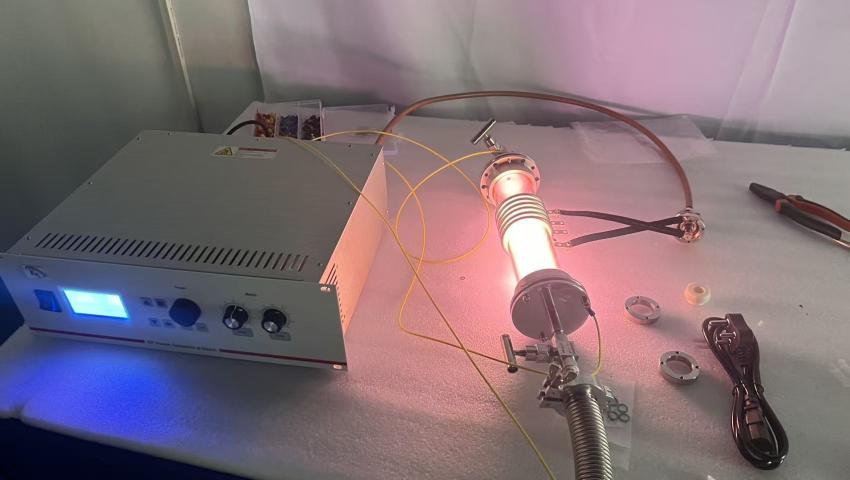
Virospuk’s work on air-breathing ion thrusters is supported by its capabilities in vacuum systems, plasma engineering, and experimental setup development. The integration of these domains allows for the creation of controlled test platforms that replicate key aspects of operational environments.
Key integration aspects include:
- Design and fabrication coordination of vacuum chambers
- Integration of RF or DC plasma generation systems
- Sensor deployment for pressure, temperature, and plasma diagnostics
- Data acquisition systems for real-time monitoring and analysis
This integrated approach enables systematic validation of subsystem performance and overall system behavior.
Key Challenges Addressed
Air-breathing ion propulsion presents several technical challenges that are central to ongoing research:
- Efficient collection of low-density atmospheric particles
- Stable plasma generation under varying intake conditions
- Optimization of ion acceleration efficiency
- Power-to-thrust ratio under constrained energy availability
- Thermal management in low-pressure environments
Virospuk’s research is focused on addressing these challenges through iterative design and controlled experimentation.
Potential Applications
Air-breathing ion thruster systems have significant potential in specialized aerospace applications:
- Very Low Earth Orbit Satellites: Continuous drag compensation without onboard propellant
- Long-Duration Missions: Reduced mass and extended operational lifetime
- Atmospheric Research Platforms: Sustained operation in upper atmospheric layers
- Experimental Aerospace Systems: Development and testing of advanced propulsion concepts
Future Direction
The long-term objective is to transition from conceptual models to experimentally validated prototypes. Future work will focus on improving intake efficiency, enhancing plasma stability, and optimizing overall system performance.
Virospuk aims to establish a dedicated experimental platform for air-breathing propulsion research, enabling further development and potential collaboration with academic and aerospace organizations.