RF Plasma Surface Treatment System — Polymer and Industrial Substrate Activation
Polyolefins (PE, PP), fluoropolymers (PTFE, PVDF), and engineering composites present a fundamental adhesion challenge: their chemically inert, non-polar surfaces resist wetting by inks, adhesives, coatings, and bonding agents. Conventional wet chemical methods — acid etching, corona discharge — either lack durability, generate hazardous waste, or provide insufficient surface energy improvement for demanding bonding applications. Low-pressure RF plasma treatment generates a highly reactive environment of ions, electrons, and UV photons that simultaneously ablates surface contamination, cross-links the near-surface polymer layer, and introduces polar functional groups (-OH, -COOH, -NH₂ depending on gas chemistry) — producing a durable, high-energy surface suitable for demanding adhesion applications.
Technical Specifications
| Parameter | Specification |
|---|
| Plasma source | RF — 13.56 MHz |
| RF power | Up to 300 W, continuously adjustable |
| Process gases | O₂, N₂, Ar, air, H₂/N₂ forming gas (user-configured) |
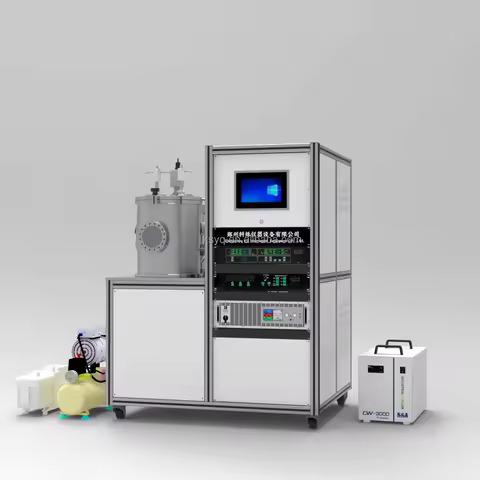
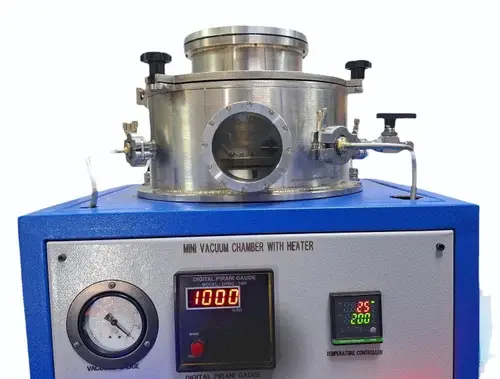
| Chamber | Large-format stainless steel — batch processing of multiple substrates |
| Vacuum system | Integrated rotary vane pump |
| Control system | PLC with programmable power, pressure, gas flow, and time recipes |
| Process monitoring | Vacuum gauge, gas flow display, power and reflected power metering |
| Power input | 220 V / 50 Hz — Indian standard |
| Certifications | CE compliant |
| Warranty | 12 months from commissioning |
Gas Chemistry and Surface Outcomes
O₂ plasma maximises surface energy increase on polyolefins — contact angles of < 5° achievable on PP and PE. N₂ and NH₃ plasma introduces amine groups (-NH₂) — preferred for biological surface functionalisation. Ar plasma provides physical activation with minimal chemistry change — preferred where surface energy increase is needed without introducing specific functional groups.
Typical Applications
- PTFE, PVDF, and PFA surface activation for adhesive bonding in medical and chemical applications
- PE and PP film activation for printing, coating, and lamination
- Carbon fibre composite surface preparation for structural adhesive bonding
- Medical device polymer surface functionalisation for biomolecule immobilisation
- Textile fibre surface treatment for improved dye absorption and coating adhesion
- Flexible substrate (PET, PI) activation before thin film deposition
Virospuk will configure the gas delivery, power level, and process recipe for your specific polymer substrate and adhesion application.