Plasma Cleaner — Laboratory Surface Activation and Contamination Removal
Surface contamination at the sub-monolayer level — hydrocarbon adlayers, atmospheric dust, native oxide residues, and photoresist remnants — dramatically affects adhesion, wettability, and electrical contact resistance in semiconductor devices, MEMS structures, microfluidic chips, and thin film devices. Wet chemical cleaning can remove bulk contamination but often leaves residues and cannot reliably activate surface chemistry. Low-pressure plasma cleaning addresses both problems simultaneously — the energetic ions and radicals in an oxygen or argon plasma physically sputter and chemically oxidise surface contaminants, while simultaneously activating surface functional groups to improve wettability, adhesion, and bonding strength.
Virospuk engineers will specify the correct plasma power, gas chemistry (O₂, Ar, air, or O₂/Ar mixture), and process time for your substrate material and surface chemistry requirement.
Technical Specifications
| Parameter | Specification |
|---|
| Plasma source | RF plasma — 13.56 MHz |
| RF power | Variable, 0 to 100 W — adjustable for sensitive substrates |
| Process gases | O₂, Ar, air, or O₂/Ar mixture (user-supplied cylinders) |
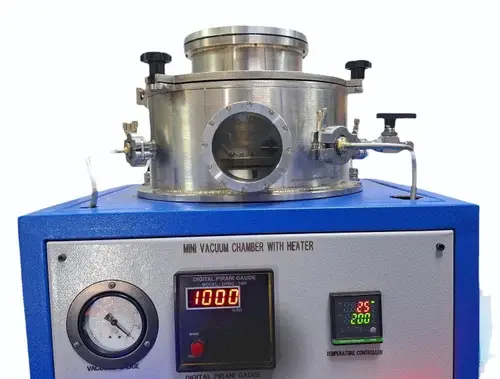
| Chamber | Borosilicate glass cylinder or stainless steel (model-dependent) |
| Vacuum system | Integrated rotary vane pump — no separate pump required |
| Working pressure | 20 Pa to 100 Pa (typical plasma operating range) |
| Process time | 1 second to 60 minutes — programmable digital timer |
| Substrate capacity | Up to Ø 150 mm (6-inch wafer) per batch (model-dependent) |
| Sample stage | Fixed or rotating (model-dependent) |
| Power input | 220 V / 50 Hz — Indian standard |
| Certifications | CE compliant |
| Warranty | 12 months from commissioning |
Surface Effects by Gas Chemistry
Gas selection determines the surface outcome. Oxygen plasma is most effective for organic contamination removal (hydrocarbon layers, photoresist residues) and generates hydrophilic -OH and -COOH surface groups on most substrates — essential for PDMS microfluidic chip bonding and adhesion layer preparation. Argon plasma provides physical sputtering without chemical modification — preferred for metal surfaces where oxidation must be minimised. Air plasma provides a cost-effective alternative to oxygen plasma for routine cleaning where strict process control is not required.
Typical Applications
- Silicon wafer and glass substrate cleaning immediately before thin film deposition
- Photoresist descum — removing residual resist in lithographically-defined openings
- PDMS microfluidic chip bonding — oxygen plasma activation of both mating surfaces
- ITO anode surface activation for OLED and organic photovoltaic device fabrication
- Metal electrode surface cleaning before wire bonding in semiconductor packaging
- TEM copper grid cleaning before sample mounting
- Polymer substrate surface activation for printing, coating, and adhesive bonding
- SEM specimen holder and stub cleaning before sample mounting
Plasma cleaning is one of the highest-impact, lowest-cost process improvements available in a thin film or device fabrication laboratory. Contact Virospuk to specify the correct power and gas configuration for your substrate system.